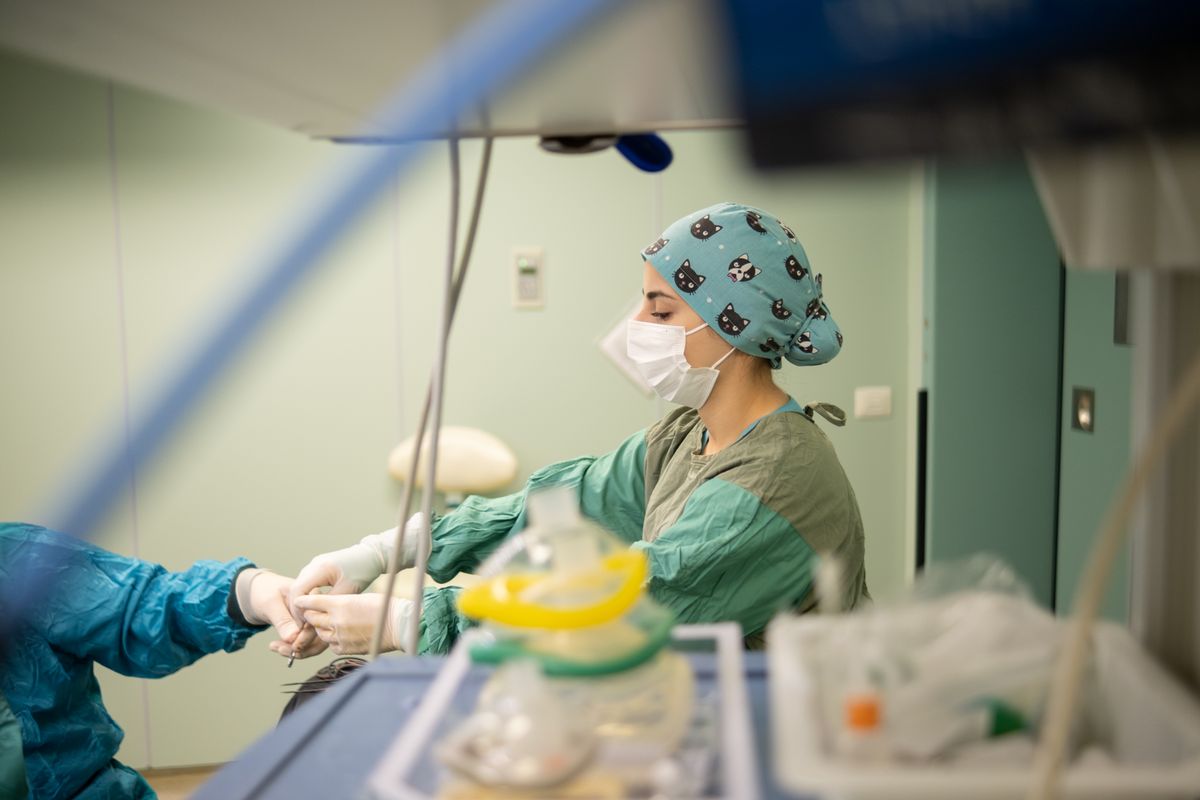
If you want to leave the chaos of a 5-patient assignment without leaving the clinical depth of critical care, the PACU — post-anesthesia care unit — is worth a serious look. You're managing one to two patients at a time, working predictable shifts (no nights at most facilities), and your clinical skills stay sharp because your patients are genuinely unstable for the first 30–90 minutes post-op.
Staff PACU nurses earned $92,739/year on average ($44.59/hr) in 2026, with the top 10% clearing $143,963. Travel PACU positions averaged $2,247/week as of April 2026 — 4% above the national travel nursing average — with premium markets like California hitting $2,706/week and New York at $2,674/week (Vivian, April 2026).
Here's what the PACU actually involves, what it takes to get there, and whether the specialty fits your career trajectory.
What Is a PACU Nurse?
PACU nurses — also called perianesthesia nurses or post-anesthesia care nurses — manage patients immediately after surgery or a procedure requiring anesthesia. Your job is to monitor for and treat the complications that emerge as patients metabolize anesthetic agents: airway obstruction, laryngospasm, respiratory depression, hemodynamic instability, nausea, pain, hypothermia, and emergence agitation.
The typical PACU is divided into two phases:
- Phase I (Immediate Recovery): Highest-acuity. One-to-one or one-to-two ratios. Patients are unconscious or minimally responsive, on supplemental oxygen, and require continuous monitoring until they meet discharge criteria. This is where the critical care skills matter.
- Phase II (Extended Recovery / Discharge Prep): Lower acuity. Patients are awake and being prepped for discharge home or to a hospital floor. Think outpatient surgical centers, ambulatory care. Ratio opens to 1:3 or 1:4.
Most hospital PACU nurses rotate through both phases. Freestanding ambulatory surgical centers tend to be Phase II-heavy, which is lower intensity but also lower pay. Know which environment you're walking into.
PACU Nurse Salary in 2026
Salary data from three sources aggregated for 2026:
| Setting | Avg Annual | Avg Hourly | Source |
|---|---|---|---|
| Staff PACU (national avg) | $92,739 | $44.59 | Sigma Nursing, 2026 |
| Top 10% staff | $143,963 | $69.21 | Sigma Nursing, 2026 |
| Travel PACU (national avg) | $116,844 annualized | $2,247/wk | Vivian, Apr 2026 |
| Travel PACU — California | $140,712 annualized | $2,706/wk | Vivian, Apr 2026 |
| Travel PACU — New York | $138,648 annualized | $2,674/wk | Vivian, Apr 2026 |
| Travel PACU — top contracts | — | up to $3,634/wk | Vivian, Apr 2026 |
Travel PACU rates are 4% above the national travel nursing average of $2,155/week — not the stratospheric premiums of ICU or ER travel, but the lower-acuity Phase II environment makes assignment adaptability significantly easier. Many travel PACU nurses pick up the pace by stacking back-to-back contracts in high-cost markets.
Geographic variation matters. California and New York consistently lead on PACU pay due to state-level staffing legislation and high cost of living adjustments. Florida runs 11% below the national travel average. If pay is the primary driver, plan your geographic strategy early.
How to Become a PACU Nurse
PACU nursing is not an entry-level specialty. The standard pathway:
- Get your RN license. ADN or BSN both qualify. Most hospital PACU units prefer BSN, and CPAN certification requires it or equivalent hours.
- Get your BLS and ACLS. Non-negotiable. You will be managing airway complications and arrhythmias from day one. PALS is a plus if you want to work with pediatric surgical patients.
- Work 1–2 years in a high-acuity bedside setting. ICU, ER, or a step-down unit. This is where you build the assessment speed and hemodynamic intuition PACU requires. Nurses who come from med-surg backgrounds tend to struggle with the acuity spike in Phase I.
- Apply to PACU positions. Be direct about your critical care background in your cover letter. Hiring managers are looking for nurses who already know what a pressure of 80/50 means and what to do about it — not nurses who need to be taught basic assessment.
- Complete PACU orientation. Typically 3–6 months of structured preceptorship. You'll learn the unit's workflow, anesthesia handoff protocols, pain management algorithms, and Phase I/II discharge criteria.
- Pursue CPAN certification once you have 1,800 hours of perianesthesia experience. More on this below.
CPAN and CAPA: The PACU Certifications Worth Getting
Two specialty certifications exist for perianesthesia nursing. Both are issued by the American Board of Perianesthesia Nursing Certification (ABPANC).
CPAN — Certified Post Anesthesia Nurse
The primary PACU certification for Phase I (immediate post-anesthesia) nurses. Eligibility requires:
- Current RN licensure
- 1,800 hours of direct perianesthesia nursing practice within the 2 years preceding application
- At least 875 of those hours must be in Phase I (immediate recovery)
The exam is 170 questions, 3.5 hours. It covers airway management, respiratory complications, cardiovascular emergencies, pain management, fluid balance, and perianesthesia pharmacology. Pass rate runs around 78–82% for first-time takers.
CPAN certification typically adds $2–5/hour to your base pay, depending on the facility and union contract. Some hospitals pay a flat certification stipend ($1,500–$3,000/year). The certification is valid for 3 years and requires 60 CE credits or retesting to renew.
CAPA — Certified Ambulatory Perianesthesia Nurse
Designed for Phase II and ambulatory surgical center nurses. Same ABPANC issuer, same 1,800-hour requirement, but the 875-hour floor shifts to Phase II or ambulatory practice. If you work in an outpatient surgical center or same-day surgery unit, this is your cert. The CAPA exam follows the same format and renewal cycle as CPAN.
| Cert | Focus | Hours Required | Pay Impact |
|---|---|---|---|
| CPAN | Phase I (inpatient PACU) | 1,800 total / 875 Phase I | +$2–5/hr |
| CAPA | Phase II / Ambulatory | 1,800 total / 875 Phase II | +$1–4/hr |
PACU vs. OR Nursing: What's Actually Different
A lot of nurses confuse PACU with OR nursing or assume they're interchangeable. They're not. Here's the practical breakdown:
| PACU Nurse | OR Nurse (Perioperative RN) | |
|---|---|---|
| Setting | Post-anesthesia recovery room | Operating room (sterile field) |
| Patient status | Coming off anesthesia, monitors active | Anesthetized, sterile procedure underway |
| Role | Assessment, pain mgmt, airway watch | Circulator or scrub — procedure support |
| Patient ratio | 1:1 to 1:2 (Phase I); 1:3 (Phase II) | Usually 1:1 per case |
| Shift type | Days/evenings, predictable, call rare | Days + call, on-call frequent |
| Primary skills | Hemodynamic monitoring, airway, pain | Sterile technique, surgical instruments |
| Certification | CPAN / CAPA | CNOR |
| Avg salary | $92,739/yr | $107,000/yr |
OR nursing pays slightly more but comes with mandatory call rotations that significantly erode work-life balance for many nurses. PACU is the better fit if you want clinical intensity without the OR's call obligations. Nurses who cross-train between OR and PACU are highly marketable — and travel agencies pay premium for that dual certification profile.
The Work Environment: What PACU Nursing Actually Looks Like
Your shift starts before any patients arrive. You're checking your bay: oxygen source, suction, IV pumps, crash cart proximity, warming blankets. The anesthesia team will give you 30 seconds to two minutes of handoff — patient name, procedure, anesthetic agents used, last BP, last SpO2, reported allergies, estimated blood loss, and any intraop concerns. That's all you get. Absorb it fast.
The first 15 minutes post-transfer are the highest-risk window. You're watching for respiratory depression, laryngospasm, desaturation, and hemodynamic instability. Most events that require intervention happen here. After that, your job shifts to pain management, nausea treatment, temperature correction, and discharge planning.
Compared to ICU nursing, PACU is faster-paced in short bursts but overall less emotionally heavy. Patients are with you for 30–120 minutes, not days or weeks. You don't form long-term patient relationships. The moral distress load is lower. The physical demand is lower — no turning 250-pound intubated patients, no 12-hour continuous drip titrations. The pace matches the surgical schedule: early morning is the heavy period, late afternoon quiets down.
One real downside: you are downstream of OR scheduling. Delays in the OR push into your shift. A board that looks like it clears at 1500 can run to 1800. On call is common at smaller facilities. Ask about the call frequency during your interview — it varies widely and it matters.
Is PACU Nursing the Right Move for You?
PACU fits a specific nurse profile. You're the right candidate if:
- You have solid ICU or ER fundamentals and want to use them without the ICU's patient load and documentation burden
- You value predictable hours — most hospital PACUs are days/evenings, with low overnight demand
- You want lower patient ratios (1:1 in Phase I) without going into management
- You're interested in surgery-adjacent care without scrubbing into cases and learning instrument sets
- You want a clear certification pathway (CPAN) that translates directly to a pay bump
PACU is not the right move if you want long-term patient relationships, complex chronic disease management, or the adrenaline of a truly unpredictable environment. The PACU rarely has the sustained urgency of a trauma bay — it has acute events in a controlled setting. Different skill set, different reward structure.
If you're eyeing travel nursing and want a specialty with strong demand and manageable adaptability, PACU is underrated. The job requirements (ACLS, Phase I experience) are standardized enough that agencies can place you consistently, and the $2,247/week national average gives you a livable travel income without needing to hit the top of the ICU market.
Calculate Your PACU Travel Pay
See what a PACU travel contract actually nets after taxes — stipends, tax home status, and gross vs. take-home math.
Open the Stipend Calculator →