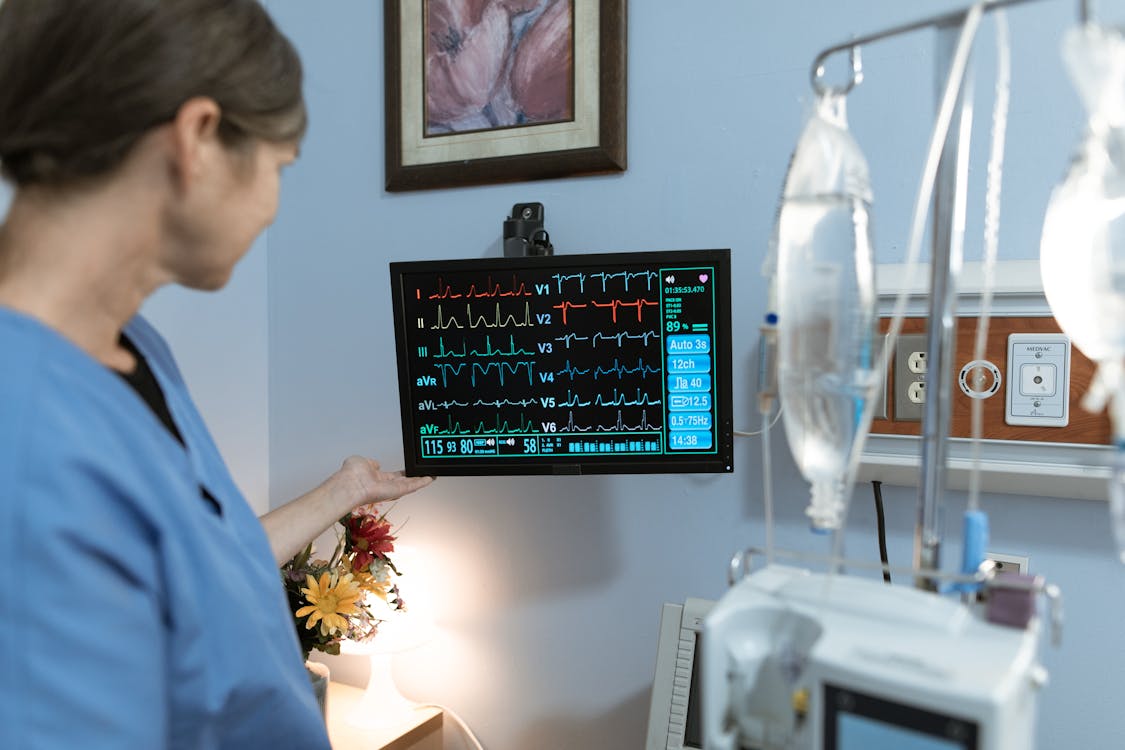
Telemetry nursing sits in the middle of the hospital acuity spectrum — sicker than med-surg, not as acute as the ICU. That middle ground is where rhythm strips run all shift, where you catch the AFIB with RVR before it becomes a code, and where you develop the cardiac pharmacology fluency that follows you into every specialty after. It's one of the most common hospital specialties, and in 2026, it pays better than most people think.
National average is $45.34/hr ($94,307 annualized) based on Vivian's active jobs as of May 9, 2026. That's below ICU rates but above general med-surg. Add PCCN certification, pick the right state, or go travel, and you're looking at $110K–$130K+ before you've set foot in a step-up unit.
Here's a complete breakdown of what telemetry nurses do, what they earn, how to get certified, and how to use this specialty as a launchpad.
What Telemetry Nurses Actually Do
Telemetry floors — also called step-down units or progressive care units (PCUs) — bridge the gap between the ICU and general medical floors. Patients are hemodynamically monitored but stable enough to not require one-to-one nursing. In practice, ratios run 3:1 to 5:1 depending on facility, union status, and state. California's mandated 4:1 PCU ratio is the gold standard; most of the country isn't there yet.
Your core responsibilities: continuous cardiac monitoring via centralized telemetry, interpreting 12-lead EKGs, managing drips (heparin, diltiazem, amiodarone, nitro), and escalating to the ICU when the rhythm tells you it's time. Common patient populations include post-MI, post-cardiac cath, CHF exacerbations, AFIB with rate control, syncope workups, and overflow from the ICU. You'll also manage diabetic patients on insulin drips, post-surgical patients requiring monitoring, and any patient the ER isn't comfortable admitting to the floor without closer eyes.
The rhythm interpretation piece is what separates telemetry from general nursing. By the time you've worked 6 months, you should be able to identify normal sinus rhythm, sinus bradycardia and tachycardia, AFIB, AFLUTTER, PVCs (isolated, couplets, bigeminy), VT, VF, heart blocks (1st, 2nd degree types I and II, 3rd degree), paced rhythms, and ST changes at a glance. Hospitals typically provide an EKG course; ACLS reinforces the interventions.
Telemetry Nurse Salary in 2026
Vivian's market data as of May 9, 2026 shows a national average of $45.34/hr for telemetry nurses, which annualizes to roughly $94,307 on a standard 2,080-hour year. Night shift differentials ($3–8/hr), weekend differentials ($3–5/hr), and charge nurse differentials ($2–5/hr) can push take-home significantly higher. A telemetry nurse working nights in California with a charge differential is clearing $115K+ in base before overtime.
PCCN certification adds a documented pay differential at most facilities — typically $1–3/hr — and is often factored into clinical ladder advancement tiers that carry lump-sum bonuses of $1,000–$2,500/yr. If your hospital has a clinical ladder, getting PCCN is almost always worth the exam cost within the first year.
State-by-State Telemetry Nurse Salary
Pay varies dramatically by state. California's union infrastructure and mandated ratios push wages far above national averages. New England states are also strong. The South and Midwest tend to trail, though lower cost of living can offset some of the gap. Here are the top-paying states based on Vivian's May 2026 active job data:
| State | Avg Hourly | Max Hourly | Annualized Avg |
|---|---|---|---|
| California | $76.00 | $95.00 | ~$158,000 |
| Massachusetts | $63.00 | $71.00 | ~$131,000 |
| Wisconsin | $60.00 | $66.00 | ~$125,000 |
| New York | $57.00 | $81.00 | ~$119,000 |
| Minnesota | $54.00 | $59.00 | ~$112,000 |
| National Avg | $45.34 | — | ~$94,000 |
California's top rate of $95/hr isn't limited to veterans. Highly specialized or unionized facilities in the Bay Area and LA can hit those numbers for experienced telemetry nurses. New York's $81/hr ceiling reflects Manhattan ICU-adjacent facilities. Wisconsin's strong showing surprises people — aggressive union contracts at several large health systems are driving it.
Travel Telemetry Nursing
Travel telemetry is one of the more accessible travel specialties. The skill set (rhythm interpretation, ACLS, drip management) is standardized enough that hospital systems trust travelers on tele floors, and the positions are consistently available. Vivian's 2026 data shows an average travel rate of $2,329/week — lower than ICU travel ($2,600–$3,200/week) but higher than med-surg ($1,900–$2,100/week) and more consistently available than niche specialties like CVOR or flight.
Most travel telemetry contracts require: 1–2 years of recent telemetry experience, current ACLS, BLS, and often hospital-specific EKG competency tests that agencies prep you for. Crisis rate contracts during census surges can push to $3,000–$4,000+/week, though those are volatile and shouldn't anchor a financial plan.
Travel tip: Telemetry is a strong entry point to travel nursing. The skills are transferable, positions are abundant, and facilities are more willing to orient travelers than in higher-acuity units. After 1–2 travel contracts, you have enough rhythm strips behind you to consider ICU transition programs.
If you're deciding which travel agency to use, the TND travel nurse agency comparison breaks down pay packages, housing stipend structures, and recruiter reputations across the major players. Telemetry positions are one of the top categories on that page by volume.
PCCN Certification: What It Is and How to Get It
PCCN (Progressive Care Certified Nurse) is the standard certification for step-down and telemetry nurses. It's awarded by AACN — the same organization that runs CCRN for critical care — and it carries real weight in clinical ladder advancement and hiring decisions at Magnet hospitals.
Eligibility Requirements
To sit for the PCCN, you need 1,750 practice hours in direct care of acutely ill adult patients within the past two years. There's no minimum years-of-experience requirement beyond that. If you're working full-time telemetry (about 150 hours/month), you're eligible after roughly 12 months. Part-time nurses get there around 18–20 months.
What the Exam Covers
The PCCN is a 125-question computer-adaptive exam, 80% focused on clinical judgment for adult progressive care patients and 20% on professional caring and ethical practice. High-yield PCCN topics overlap heavily with what you see on tele every shift: cardiac arrhythmias, heart failure management, anticoagulation, respiratory failure, sepsis protocols, and hemodynamic monitoring basics. If you're managing AFIB, CHF, and heparin drips daily, most of the content won't be foreign.
Cost and Prep
AACN member exam fee: $250. Non-member: $350. Most hospitals reimburse the fee on passing, and many will pay for a prep course. Pass rates run around 75–80% for first-time candidates. Standard prep: AACN's own study materials, PassCCRN or similar question banks, and 6–8 weeks of focused review. Renewal is every 3 years, requiring 100 CERPs (continuing education hours) or retaking the exam.
How to Break Into Telemetry Nursing
Three realistic paths into telemetry:
Path 1: Direct New Grad Hire
Many hospitals hire new grads directly to telemetry floors, especially those with robust residency programs. If you're a nursing student, targeting a clinical rotation on a PCU or step-down unit increases your hire chances significantly — managers want to see that you've held a rhythm strip before. You'll complete an EKG rhythm interpretation course in orientation (typically 2–4 weeks) and likely work alongside a preceptor for 8–12 weeks before independent practice.
Path 2: Med-Surg to Tele Transition
The traditional path: 1–2 years of med-surg, then lateral into telemetry. The time management and assessment skills from med-surg transfer directly. Your biggest prep work is rhythm interpretation — pick up an EKG workbook (Dale Dubin's Rapid Interpretation of EKG's is the standard), complete an online rhythm course, and be ready to demonstrate basic arrhythmia recognition in your interview.
Path 3: ICU Step-Down
If you've been in the ICU and want a lower-acuity option without going all the way to med-surg, telemetry is a natural fit. You'll already have the cardiac pharmacology and rhythm skills. The adjustment is accepting higher patient ratios and less 1:1 time per patient — which some ICU nurses find difficult and others find refreshing.
Career Advancement from Telemetry
Telemetry is a genuine springboard. The cardiac and hemodynamic foundation you build is directly relevant to ICU practice, CRNA programs, and NP specialization in cardiology or acute care. Common advancement paths from telemetry:
- ICU transition: Many hospitals offer formal tele-to-ICU bridge programs, especially for nurses with PCCN and 2+ years of step-down experience. CCRN prep is realistic within 1–2 years of ICU work.
- Travel nursing: 12–18 months of tele experience opens the full travel market. See the ICU-to-travel nursing guide for the financial math.
- CRNA pathway: Telemetry counts toward CRNA admissions requirements as "critical care experience" at some programs — check individual program definitions. ICU experience is strongly preferred, but some programs accept step-down with demonstrated hemodynamic monitoring skills. Our CRNA career guide covers the full pathway.
- NP specialization: Acute Care NP and Adult-Gerontology Acute Care NP programs draw heavily from cardiac and step-down experience. Your PCCN background is a genuine advantage in program applications.
- Charge/management: Telemetry floors value nurses who can manage patient flow and mentor newer staff on rhythm interpretation. Charge nurse is a realistic 2–3 year goal; nurse manager in 5–7 years depending on facility and interest.
See What Your Telemetry Pay Is Worth
Run your current hourly rate through the overtime calculator or benchmark your take-home against the national data. Free tools, no login required.
Telemetry Nursing: Frequently Asked Questions
How much do telemetry nurses make in 2026?
Telemetry nurses average $45.34/hr ($94,307/yr) nationally as of May 2026 (Vivian active jobs). California leads at $76/hr average, up to $95/hr maximum. Travel telemetry nurses earn $2,329/week on average.
What is PCCN certification and do I need it?
PCCN (Progressive Care Certified Nurse) is AACN's certification for step-down and telemetry nurses. You need 1,750 practice hours in progressive care within 2 years. The exam is 125 questions, costs $250 (member) or $350 (non-member), and most hospitals reimburse on passing. It's not required, but it adds $1–3/hr to your pay at most facilities and is expected for clinical ladder advancement.
How do I become a telemetry nurse?
Complete an ADN or BSN, pass NCLEX-RN, then apply to step-down or cardiac telemetry units. Many hospitals hire new grads directly with EKG training provided in orientation. Get ACLS within 6 months of hire — it's required at most tele floors within that window.
Is telemetry nursing a good specialty?
Yes. Competitive pay at $94K+ nationally, consistent demand (telemetry is one of the most common hospital specialties), and the rhythm interpretation and cardiac pharmacology skills you develop are transferable to ICU, CRNA programs, and NP specialization. It's one of the cleaner paths to either higher acuity or higher pay.
What's the ratio on a telemetry floor?
Typically 3:1 to 5:1, varying by state, facility, and union status. California mandates 4:1 for PCU/step-down. Outside California, 4:1 to 5:1 is common. Some facilities run 3:1 on nights with lower census. Ratios are a legitimate negotiation point and worth asking about in interviews.